Tuesday, May 29, 2012

Ideas for posts: Let me know what you want!

I've had some comments on this blog leading me to believe that these posts are helping students. I'd like to know more about who you are and what class you are taking. Is it a high school level class or other?

Email me at julieawissd@yahoo or leave a comment here.

Also: Do you have specific topics you would like me to write about here? What are they?`

Thursday, May 17, 2012

Graph for determining polarity based on shape for Lewis Dot/VSEPR theory


This by far the best diagram I've seen for determining polarity based on shape. I've taught from three different textbooks now and never seen it explained so well. See my previous post about determination of electronegativity. You need do that before you can determine shape.

Sunday, April 8, 2012

Electronegativity and gradation of ionic bond


The top figure here shows the trends of electronegativity on the periodic table. The concept of electronegativity can be most simply thought of as the ability of an atom to suck electrons toward it. Atoms on the left of the periodic table have low electronegativities. This makes sense since they actually tend to lose electrons to form positively charged atoms. The steps on the periodic table become steeper toward the right and top where atoms tend to have the highest ability to suck electrons into their centers.

When two atoms with different electronegativities come together as a molecule, the difference in their electronegativity values becomes the dipole moment of the molecule (see drawing). Basically, one side of the molecule feels a partial negative charge while the other side feels a partial positive charge. (The symbols that represent this are also included on the figure with + and - signs). A molecule with a dipole moment is a polar covalent compound.

You can actually calculate numerically the difference in the electronegativity. See the numerical values for each element on the periodic table at the top. The difference in electronegativity determines the degree of polarity of the covalent bond. When the difference in electronegativity becomes very great, the bond is no longer covalent (or polar covalent) but is considered an ionic bond. In an ionic bond the electrons are no longer considered shared between atoms. In the ionic bond the electrons are donated from atom to atom.

The Periodic Table and Ionic and Covalent Bonding


At this point a discussion of the periodic table is useful. A look at the periodic table helps you understand why certain elements share outer electrons while other elements donate their electrons to another atom. The two versions of the periodic table below are slightly different in that one shows the details of the elements on it while the other one shows large categories of elements only. Both convey the same information in a slightly different way.

The main group elements span both sides of the periodic table and form a sandwich on either side of the transition metals. The main difference between main group elements and transition elements is that the charges or partial charges on the main group elements are much easier to predict in any molecule. Many of the transition elements form species with varying charges. Often the only way to figure out the charge within the compound is to base it on the negatively charged atom, typically a main group element.

Generally, metals exist on the left side of the table and nonmetals on the right. The metals tend to lose electrons to form a + charge on an atom while the nonmetals tend to gain an electron to form a - charge on an atom.

In an ionic compound, the + and - charged atoms come together in an attractive bond. Thus typically this bond is made from one atom on the left side of the PT while the other atom is from the right of the PT.

The covalently bonded compounds, on the other hand, typically come from two nonmetals on the right hand side of the table. Since nonmetals tend to form - charged atoms, the attraction between two - charged atoms is obviously not a +/- charge. It is nothing like this because the outer electrons of both atoms rearrange themselves to form a more stable arrangement of shared electrons between the two atoms.

The top periodic table shows certain elements in yellow. These are elements that tend to form gases like H2, O2, F2, Cl2 and others. We call these diatomic gases (as the label indicates). These have very pure covalent bonds between atoms because the properties of each atom are exactly the same.

Visual picture of single ionic bond next to single covalent bond

 If we strictly talk about the base unit of an ionic compound and the base unit of a covalent compound we can show pictorially the physical difference between these two types of bonds. See figure below.


The melding of the two nuclei on the left (H-F bond) shows the sharing of outer electrons while the distinct nature of each atom of the NaCl demonstrates the +/- nature of the ionic bond.

Covalent Bonding Continued

So if covalently bonded structures do not form lattices of repetitive atoms then what kind of molecular arrangements do they form?

In a covalently bonded molecule, the outer electrons of one atom overlap with the outer electrons of another atom. While this does involve a bit of +/- attraction (like ionic bonding) in many cases, it does not create a strictly attraction/repellent nature of charged ions in the ionic bond.

In the figure above, a fluorine atom is covalently bonded to a hydrogen atom. You could also say that they are sharing their outer electrons. Because fluorine and hydrogen have different properties of a term called electronegativity they are not equally sharing the electrons in each of their outer shells. However, the sharing is equal enough to consider the bond a covalent one.

Often, groups of covalently bonded atoms are held together in liquid or solid form by forces of attraction between molecules. While these forces are not strong enough to be considered covalent bonds, they are often strong enough to render a substance a liquid or solid at room temperature instead of a gas (molecules flying all over the place in a gas and not held together by forces).


The diagram in blue shows a three-dimensional picture of a single molecule of water. Many people even outside of the chemical world are familiar with the word H2O as being synonymous with water. The purpose of this simple drawing is to show the outer electrons in water as both bonded to atoms (in this case hydrogen) and existing as free-floating electrons called lone pairs. The two lone pairs each have their own balloon . Since there are four sets of outer electrons here, they distribute themselves at equal angles from the center to minimize repelling against each other. This creates the most basic covalently bonded structure that we commonly refer to as a tetrahedral.

Interestingly, water molecules use these lone pairs to stack themselves into repetitive patterns that are not lattices (no ionic bonding involved) but allow them to stick together strong enough to form a liquid at room temperature. (Note that most other molecules the same size as water as gases at room temperature) See my post on this for more information on my other blog.

Saturday, April 7, 2012

Covalent bonding

An ionic bond was described in previous posts on this blog. Now I want to focus on a covalent bond. This is different from an ionic bond in that it is not an attraction of a positive and negative charge on two atoms.
Notice how in these covalently bonded molecules above, the atoms of the basic unit have a distinct shape with bond angles. These distinct molecules are generally not held together in a rigid lattice structure (at room temperature) that looks like this: (for ionic bonding)
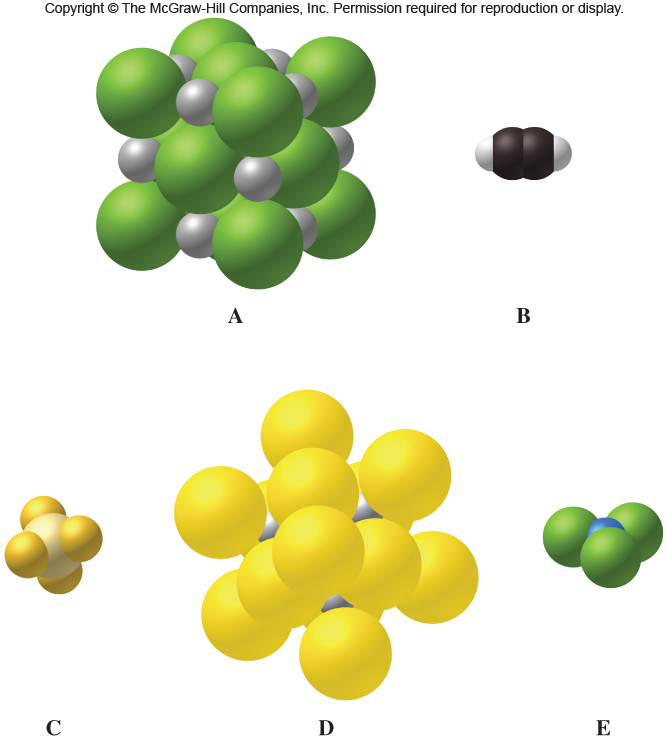
The structures in green, red and black are ionically bonded lattice structures while the sulfur dioxide and carbon dioxide above covalently bonded shapes.

If you put them next to each other (to compare) they look like this (see below):

Can you tell which structures are ionic lattices and which are covalent? In the final diagram the two structures are mixed together.